

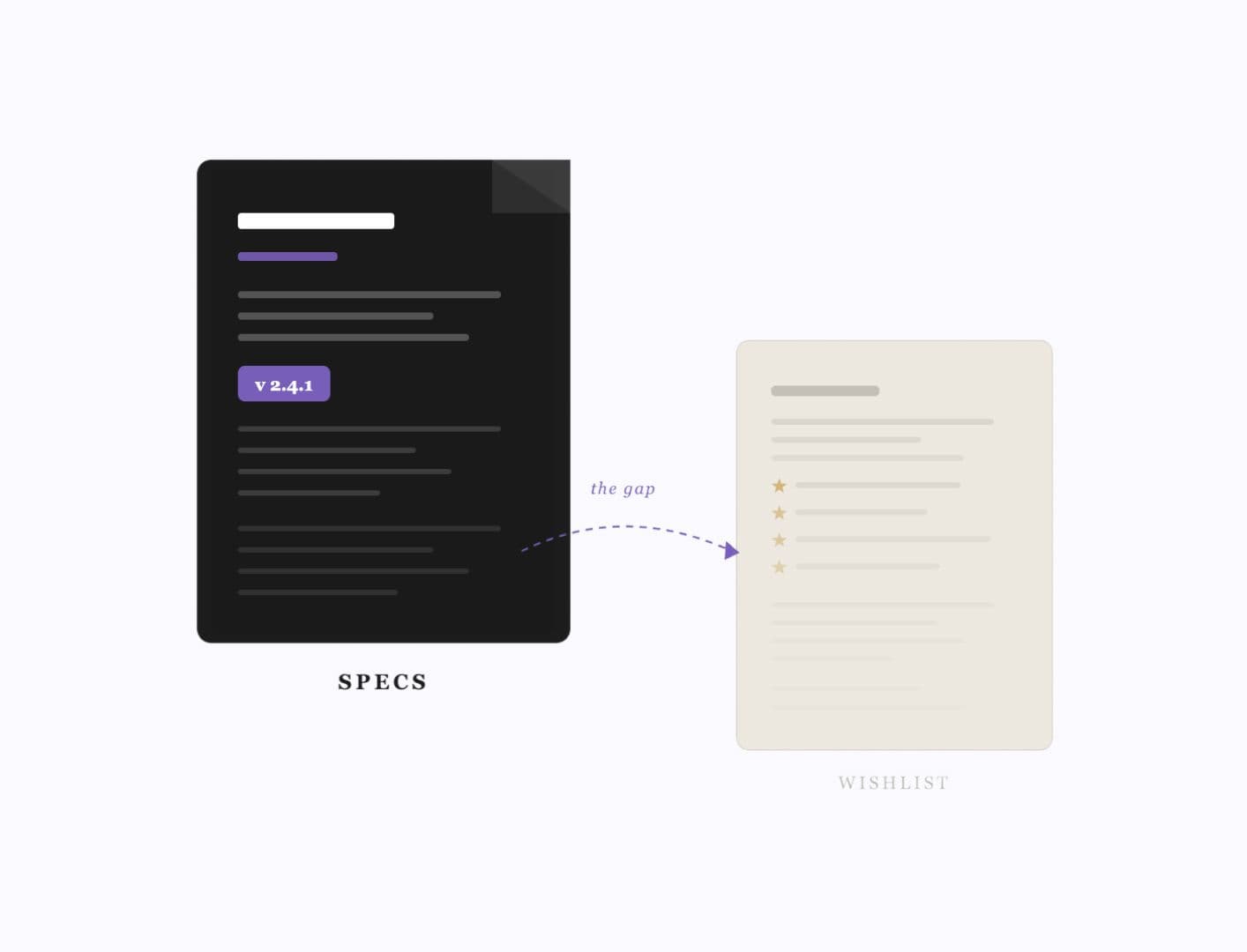
80% of a real technical specification is about what happens when things go WRONG. What if the internet drops mid-payment? What if the bank server freezes at the exact moment of the transaction? What if the user hits "back" in the browser halfway through checkout? These are called edge cases. And almost no one thinks about them on their own - simply because when you picture your product, you picture it working perfectly. In an ideal world. But development is about the real one.
You're the expert in your business. That's exactly what we need.
A client came to us recently with a finished spec - 12 pages, detailed, with mockups, even button colors. We sat down to go through it together. Two hours later, we'd found 34 scenarios the document didn't cover at all. What happens if a user uploads a file in the wrong format? If the session expires mid-form? If a promo code is valid but the item is out of stock? Not a word. Not because the client hadn't thought carefully - but because he was thinking like a founder, not like a developer. And that's exactly as it should be.
Your job is to bring the business requirements: who your audience is, how the product makes money, and which features matter most. Everything else - system architecture, edge case logic, technical constraints - that's our side of the table.
When you try to write the technical details yourself, two things happen. First, you spend time on something you don't have experience in. Second, you unintentionally constrain the developers: they see your implementation and follow it, even when they know a better way.
What a real technical specification actually includes
1. Business context and goal
Not "what to build" - but "why anyone needs it." Who is the audience? What problem does the product solve? How does it make money? Without this, the team builds the right feature with the wrong logic. Technically correct, completely missing the point.
2. User Stories - language everyone understands
Looks simple: "As a new visitor, I want to sign up with Google so I don't have to fill in forms manually." But behind that one sentence are decisions about which library to use, how to store tokens, and what to do if an account already exists with that email. Without user stories, a technical specification is just a list of wishes that people read differently.
3. Wireframes and a clickable prototype
Text lies. Not on purpose - two people just read the same sentence differently. We draw the logic before writing the code. Black-and-white frames, no design, just structure and flow. It saves weeks in development - and eliminates 80% of misunderstandings before anything starts.
4. Edge cases - everything that can go wrong
Here's something from our own practice. A client launched payments. User clicks "Pay" - and at that exact moment, the internet drops. What does the screen show? An error? An infinite spinner? Or did the money leave the account but the order never got created? Three completely different scenarios, each with different logic. Each needs its own line in the project documentation. The average product has dozens of moments like this. Covering them all without development experience is nearly impossible to do alone.
5. Technical constraints and integrations
CRM, payment gateway, mobile platforms, and performance requirements. Feels like something you can sort out later. You can't. A question that surfaces mid-development costs several times as much as the same question asked at the start.
Common mistakes that break projects
"It should feel intuitive and user-friendly" - that's a wish, not a requirement. Intuitive for whom? Measured how?
Everything is marked as a priority. If everything is critical, nothing is. What's the MVP, and what can wait for version two?
No single person is responsible for the document. A spec is alive - it changes, and someone has to own it
Technical details instead of business logic. "Button is blue" - not a requirement. "After clicking, the user receives an email confirmation within 30 seconds" - that's a requirement
Document written after the first call, without actually digging into the idea. That's not how it works.
A project specification isn't written - it's built during Discovery
Project documentation isn't a file you send developers after a first call. It's built during a Discovery phase.
Here's what that looks like with us. A business analyst and tech lead sit down with you - and start stress-testing your idea. Not to find problems, but to understand where it's actually fragile. They ask the uncomfortable questions. Draw the flows. Surface those edge cases nobody thought about. It's not an interview - it's a crash test.
What you get at the end isn't paperwork. It's a detailed backlog, a clickable prototype, and an accurate estimate. You know exactly what it costs and exactly what you're getting. No, "we understood it differently" halfway through development.
Ready to put your idea to the real test?
At a BuildApps Discovery session, we work through your idea together - mapping edge cases, shaping the project specification, and building a clickable prototype before a single line of code is written. Clear plan, accurate estimate. No surprises along the way.